



October 14, 2026
Capgemini Exceller Interview Experience 2027
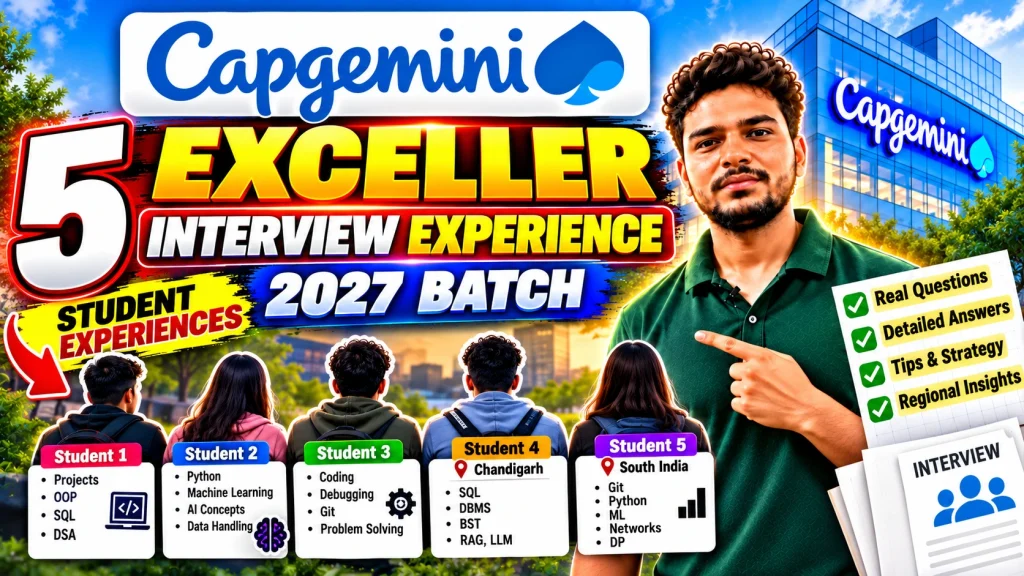
Capgemini Exceller Interview Experience 2027: 5 Student Experiences with Questions and Tips
Are you preparing for the Capgemini Exceller program? Reading a real Capgemini Exceller Interview Experience 2027 is one of the best ways to know what the interviewer will actually ask. In this article, we share 5 student interview experiences covering projects, SQL, Python, Data Structures, Machine Learning, Git, networking and HR questions.
Experiences 4 and 5 are taken from candidate-shared interview reports. Experiences 1, 2 and 3 are representative experiences built on the same pattern and difficulty level, with different questions, so you can see the wider range of topics. Regions covered are Chandigarh and South India.
What Is the Capgemini Exceller Interview?
Capgemini Exceller is a hiring and training program for freshers. The interview is usually a single technical plus HR round of about 25 to 35 minutes. Based on all five experiences below, the interviewer typically starts with your introduction and project, then moves to core subjects like SQL, DBMS, Python and DSA, adds a few modern topics like ML or GenAI, and finishes with HR-style questions.
Quick Overview of the 5 Experiences
| # | Region | Duration | Main Focus |
|---|---|---|---|
| 1 | Chandigarh | 30 min | OOP, SQL, DSA, REST API, HR |
| 2 | South India | 35 min | Python, OS, ML, SQL ranking |
| 3 | Chandigarh | 30 min | DSA, GenAI, SQL, HR |
| 4 | Chandigarh | 25 min | Project, SQL, BST, RAG/LLM |
| 5 | South India | Not mentioned | Git, SQL, Python, ML, Networking, DP |
Interview Experience 1 (Region: Chandigarh)
Duration: 30 minutes | Role: Not mentioned
The interviewer was friendly and focused on fundamentals and project clarity.
Questions asked
- Introduce yourself and explain your final-year project
- Why did you choose this tech stack for your project?
- What are the four pillars of OOP? Explain with examples
- Abstract class vs interface
- Write a SQL query to find duplicate records in a table
- Primary key vs unique key; what is an index?
- Stack vs queue; where is each used in real life?
- How do you reverse a linked list, and what is its time complexity?
- What is a REST API? Difference between GET and POST
- What are your strengths and weaknesses?
- Are you comfortable relocating and working in shifts?
Tip: For duplicates, use
GROUP BY column HAVING COUNT(*) > 1. For linked list reversal, explain the three-pointer approach (prev, current, next) with O(n) time and O(1) space. Keep HR answers honest and specific.
Interview Experience 2 (Region: South India)
Duration: 35 minutes | Role: Not mentioned
This one leaned towards Python, operating systems and applied ML.
Questions asked
- Self-introduction and your role in the project
- What was the biggest technical mistake in your project and what did you learn?
- Python: mutable vs immutable types;
==vsis - Python: what is list comprehension? Write a program to print the Fibonacci series
- SQL: find the Nth highest salary using
DENSE_RANK() - UNION vs UNION ALL; what is a subquery?
- OS: process vs thread; what is a deadlock and how can it be prevented?
- What is cross-validation and why do we split data into train and test sets?
- Explain the confusion matrix and the bias-variance trade-off
- Git: what is
git stashand when would you use it? - What is cloud computing? Name the three service models (IaaS, PaaS, SaaS)
- Where do you see yourself in five years?
Tip: Know the four conditions of deadlock (mutual exclusion, hold and wait, no preemption, circular wait). Always connect ML concepts back to your own project.
Interview Experience 3 (Region: Chandigarh)
Duration: 30 minutes | Role: Not mentioned
A balanced interview with DSA, SQL, a GenAI section and HR questions.
Questions asked
- Introduction and your internship or project experience
- Explain binary search and write the code; what is its time complexity?
- Compare bubble sort, merge sort and quick sort
- Array vs linked list; when would you prefer each?
- SQL: delete duplicate rows but keep one copy
- Subquery vs join; stored procedure vs function
- What is prompt engineering? What is hallucination in LLMs?
- Fine-tuning vs RAG: when would you use which?
- What is the difference between a process and a program? (basic OS)
- Why do you want to join Capgemini?
- Tell me about a time you worked in a team and handled a disagreement
Tip: For “Why Capgemini?”, mention its global presence, training culture and the Exceller learning path instead of generic answers.
Interview Experience 4 (Region: Chandigarh)
Duration: 25 minutes | Role: Not mentioned
This was a short, project-driven interview with a mix of technical and HR-style questions.
Questions asked
- Introduction and explain any project
- Why did you use a pre-trained model?
- Types of SQL queries; what are views and triggers; DROP vs DELETE vs TRUNCATE; ACID properties
- If you are HR, what qualities will you look for in candidates?
- What is the time complexity of deleting a node in a Binary Search Tree?
- If you need to change your tech stack, what would you choose and why?
- What is vector embedding? What are RAG and LLM?
Tip: Be ready to justify every technical choice in your project. “Why did you use a pre-trained model?” tests whether you understand transfer learning (less data, less training time, better accuracy). For BST deletion, the answer is O(h), which is O(log n) for a balanced tree and O(n) in the worst case.
Interview Experience 5 (Region: South India)
Role: Not mentioned
This was a broader, subject-wise interview covering almost every fresher topic.
Questions asked
- Explain your project and your individual contribution
- What challenges did you face in your project and how did you solve them?
- Difference between Git and GitHub; Git merge vs rebase
- How do you resolve a merge conflict? Git pull vs git fetch
- Write a SQL query to find the second highest salary
- WHERE vs HAVING; INNER JOIN vs LEFT JOIN
- What is normalization? Explain 1NF, 2NF and 3NF; primary key vs foreign key
- Python: list vs tuple; shallow copy vs deep copy
- Python: program to check whether a string is a palindrome
- Supervised vs unsupervised learning; overfitting vs underfitting and how to avoid it
- Precision, recall and F1-score; when to prefer high recall over high precision
- OSI vs TCP/IP model; TCP vs UDP and when to use each
- What happens when you type a URL in the browser and press Enter?
- Minimum coins problem using dynamic programming, with time and space complexity
Tip: Prepare the “URL in browser” flow (DNS lookup, TCP handshake, HTTP request and response) and the coin change DP problem. The DP answer is O(amount × number of coins) time and O(amount) space.
Common Topics Across All 5 Experiences
- Project discussion: asked in every interview, including your individual contribution and challenges
- SQL and DBMS: joins, keys, normalization, second/Nth highest salary, duplicates, ACID
- Python and DSA: palindrome, Fibonacci, linked lists, BST, binary search, sorting, DP
- ML and GenAI: overfitting, precision and recall, RAG, LLM, vector embeddings
- Git, networking and OS: merge vs rebase, TCP vs UDP, URL flow, process vs thread
- HR questions: strengths, weaknesses, relocation, why Capgemini, five-year goals
How to Prepare for the Capgemini Exceller Interview in 2027
- Know your project deeply. Be able to explain the problem, your tools, your exact contribution and the challenges.
- Practice SQL daily. Second highest salary, duplicates, joins and ranking functions come up again and again.
- Revise Python basics. Lists vs tuples, copy types, string programs and simple logic.
- Cover core DSA. Linked lists, BST, binary search, sorting and the basic DP pattern.
- Learn the modern topics. ML metrics, RAG, LLMs and vector embeddings are now common even for freshers.
- Prepare HR answers. Practice a clear introduction, strengths, weaknesses and “Why Capgemini?”
- Stay calm and honest. If you don’t know an answer, say so and explain how you would approach it.
Frequently Asked Questions
How long is the Capgemini Exceller interview?
Based on these experiences, it usually lasts between 25 and 35 minutes.
Is coding asked in the Capgemini Exceller interview?
Yes. Expect small programs such as a palindrome check, Fibonacci series or binary search, plus SQL queries.
Are ML and GenAI questions asked to freshers?
Yes. Topics like overfitting, precision and recall, RAG, LLM and vector embeddings appeared in these experiences, especially when your project uses AI.
Is the interview different in Chandigarh and South India?
The pattern is largely the same. Project, SQL, Python and DSA appear across regions, so prepare the full set.
Conclusion
These five student experiences show that the Capgemini Exceller Interview Experience 2027 focuses on fundamentals: your project, SQL, Python, DSA, a few ML and GenAI concepts, and clear HR answers. Prepare the topics above, practice speaking your answers aloud, and you will be ready to crack the interview.
Note: Experiences 1, 2 and 3 are representative experiences created on the same pattern and difficulty level. They are not reports from named candidates.