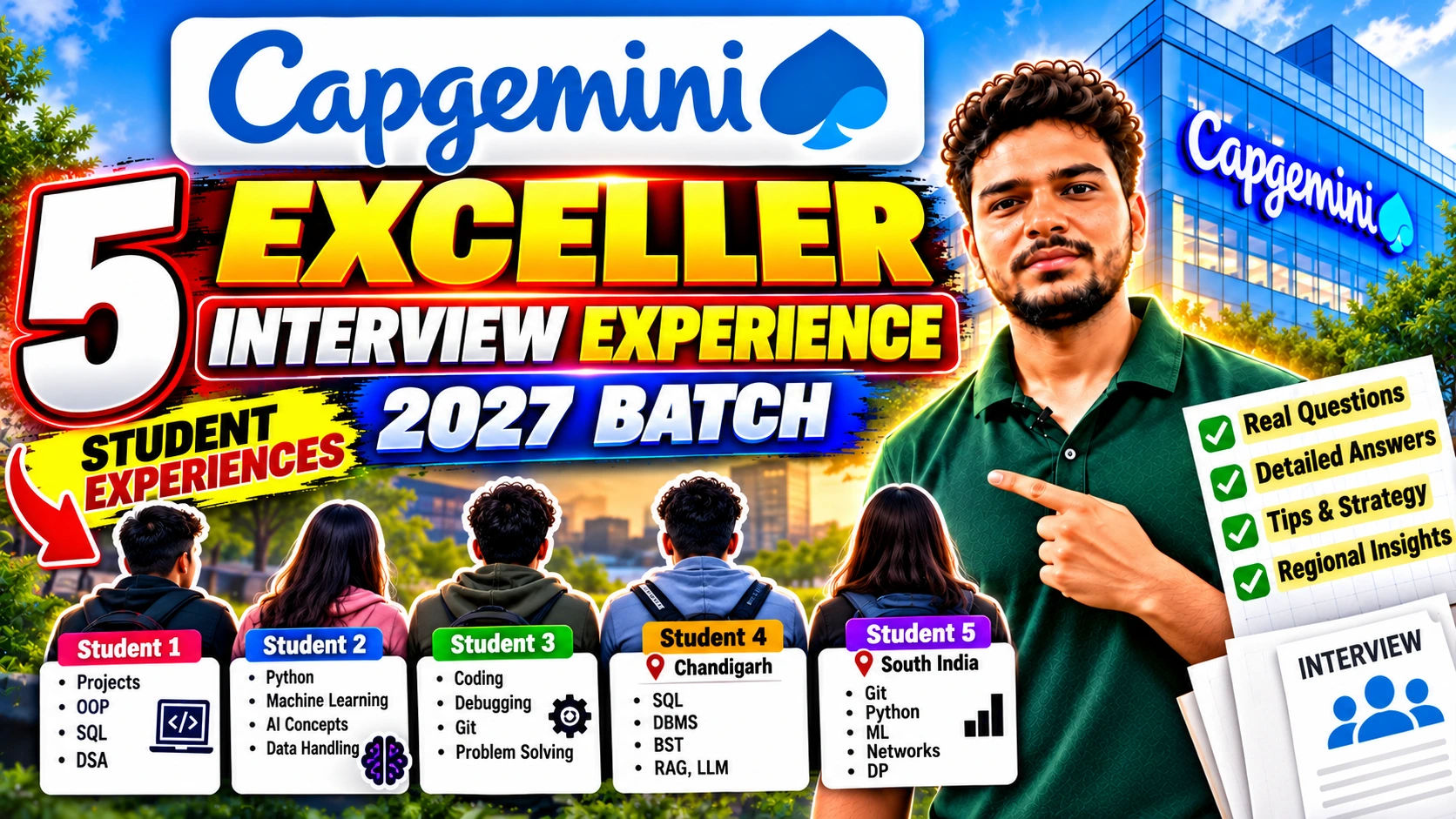
What to Expect in a Capgemini Exceller Interview
The candidate accounts summarized here describe interviews that included project questions and technical fundamentals. One account also included HR-style questions. The examples are too limited to establish a standard interview length, round structure or regional pattern. For a fresher interview, prepare to explain the work listed on your résumé. If you mention a programming language, database, machine-learning model or development tool, expect follow-up questions about how you used it and what you learned.Topics mentioned in the candidate reports
- Project overview, personal contribution and technical choices
- SQL queries, joins, keys and database concepts
- Python fundamentals and short programming problems
- Data structures, algorithms and time complexity
- Machine-learning concepts connected to a project
- Git, operating systems and networking basics
- Communication, teamwork and role-related questions
Candidate-Reported Capgemini Exceller Interview Experiences
The following two summaries are based on candidate-shared reports supplied for this article. They are presented anonymously; the reports have not been independently verified and are not official Capgemini question papers.Reported Experience 1: Chandigarh
The candidate described a project-focused conversation with technical and HR-style questions. The reported interview lasted about 25 minutes.- Introduce yourself and explain one of your projects.
- Why did you choose that project’s technology stack?
- Why did you use a pre-trained model?
- What are vector embeddings, RAG and large language models?
- What are SQL views and triggers?
- How do
DELETE,DROPandTRUNCATEdiffer? - What are ACID properties?
- What is the time complexity of deleting a node from a binary search tree?
- If you could change your project’s technology stack, what would you choose and why?
- What qualities would you look for when selecting a candidate?
Reported Experience 2: South India
This candidate-shared account covered programming, databases, machine learning, networking and problem solving. The report did not state the interview duration.- Explain your project and your individual contribution.
- What challenge did you face, and how did you address it?
- How are Git and GitHub different?
- How do merge and rebase differ? How would you resolve a merge conflict?
- Write a SQL query to find the second-highest salary.
- How are
WHEREandHAVINGdifferent? - How do an inner join and a left join differ?
- What is database normalization? Explain the purpose of 1NF, 2NF and 3NF.
- How are Python lists and tuples different?
- What is the difference between a shallow copy and a deep copy?
- How do overfitting and underfitting differ?
- How are precision and recall used to evaluate a model?
- How do TCP and UDP differ?
- What happens after you enter a web address in a browser?
- How would you approach the minimum-coin change problem?
Capgemini Exceller Interview Practice Questions
The questions in this section are original practice prompts based on the topics in the candidate reports. They are not claimed to have been asked in actual Capgemini interviews.Practice Set 1: Programming and data structures
- Write a function that checks whether a string is a palindrome. How would you handle spaces and letter case?
- Generate the first n Fibonacci numbers. What is the time complexity of your approach?
- Explain how binary search works. What condition must be true before you use it?
- Compare an array and a linked list. Give one situation where each could be useful.
- Explain how you would reverse a singly linked list.
- How would you find the height of a binary tree?
Answer approach: reversing a linked list
Keep three references: the previous node, the current node and the next node. Save the next node before changing the current node’s link. Point the current node back to the previous node, then advance both references. Continue until there are no nodes left. The usual iterative method takes O(n) time and O(1) extra space.Practice Set 2: SQL and databases
- Write a query to find duplicate values in a column.
- Find the second-highest salary. How would you handle ties?
- Explain the difference between
INNER JOINandLEFT JOIN. - When should you use
WHEREand when should you useHAVING? - What is an index, and what trade-off can come with adding one?
- Explain primary keys, foreign keys and unique constraints.
- What problem does normalization address?
Example: finding duplicate values
SELECT email, COUNT(*) AS record_count
FROM users
GROUP BY email
HAVING COUNT(*) > 1;Example: finding the second-highest distinct salary
SELECT salary
FROM (
  SELECT salary,
         DENSE_RANK() OVER (ORDER BY salary DESC) AS salary_rank
  FROM employees
) ranked_salaries
WHERE salary_rank = 2;
DENSE_RANK() gives equal salaries the same rank and does not skip the next rank. If the question asks for the second row after sorting rather than the second distinct salary, clarify that difference before writing the query.
Practice Set 3: Projects, machine learning and communication
- Describe a project you worked on in two minutes.
- Which part did you personally build?
- What was one bug or setback, and how did you investigate it?
- How did you test whether the project worked correctly?
- Explain overfitting with a simple example.
- How do precision and recall differ? Which matters more for a problem you know?
- If your project uses an LLM, what does RAG add, and what limitations remain?
- Tell me about a time you worked with someone who had a different approach.
- Why are you interested in this role?
Answer approach: explaining your project
Use a simple order: the problem, who it affects, your solution, your personal contribution, how you tested it and what you would improve. Be precise about your role. If teammates built other parts, say so rather than taking credit for the whole project.Answer approach: precision and recall
Precision asks how many items predicted as positive were actually positive. Recall asks how many actual positive items the model found. The better metric depends on the cost of each type of mistake. For example, a screening system may prioritize finding as many true cases as possible, while another use case may require reducing false alarms. Explain the trade-off in the context of the problem.How to Prepare for the Capgemini Exceller Interview
1. Prepare a project explanation and follow-up answers
Write down the project’s purpose, your contribution, the tools used, one difficult decision, one problem you fixed and one limitation. Practise answering follow-up questions without relying on a memorized speech.2. Practise SQL by writing and checking queries
Review filtering, grouping, joins, subqueries and ranking functions. Use a small sample table to check which rows your query returns. Be prepared to explain how null values, duplicate values or ties affect the result.3. Revise programming fundamentals
Choose the language you know best. Practise strings, arrays, loops, functions, basic data structures and a few easy coding problems. Explain your approach as you work through each problem.4. Review core CS concepts that appear on your résumé
Refresh operating-system basics, networking fundamentals, databases and object-oriented programming. Spend more time on concepts you have used or listed rather than trying to memorize every topic.5. Keep ML and GenAI answers grounded in your own experience
If your project uses machine learning, understand the data, model, evaluation method and limitations. If you mention RAG or an LLM, explain the basic workflow and how you checked the output. Avoid listing tools you cannot discuss clearly.6. Prepare concise HR answers
Practise your introduction, why you applied, a strength you can demonstrate and a skill you are improving. Use a real example from a project, course, internship or team activity.7. Be accurate about what you know
If you are unsure, say so. Share the part you understand and explain how you would investigate the rest. Clear reasoning is more useful than guessing or claiming experience you do not have.Frequently Asked Questions
How long is a Capgemini Exceller interview?
One candidate report summarized here gives an approximate duration of 25 minutes; the other does not state a duration. These examples are not enough to establish a standard interview length. Check your own interview invitation for the scheduled time.What topics can come up in a Capgemini Exceller interview?
The candidate reports mention project discussion, SQL, Python, data structures, databases, Git, networking, machine learning and HR-style questions. Your interview may cover different subjects based on your role, résumé and hiring process.Will I be asked to write code?
Coding and problem-solving questions appear in the reported topics and practice sets here, but no particular question is guaranteed. Practise explaining your code as well as writing it.Should I prepare machine-learning and GenAI topics?
Prioritize topics that appear in your projects, coursework or résumé. If you mention machine learning or GenAI, be prepared to explain the basic concepts and your own contribution accurately.Are all five examples actual Capgemini interviews?
No. This article contains two candidate-reported summaries and three practice sets. The practice sets are study material, not real interview accounts.Does every candidate get the same interview questions?
This article does not establish a fixed question list or process for every candidate. Questions can vary. Follow the instructions in your own recruitment communication.What should I do if I do not know an answer?
Be honest. Explain what you do know, ask a clarifying question if needed and describe how you would approach the problem. Do not invent experience or pretend to understand a concept you have not studied.How These Examples Are Presented
The two interview summaries above are based on candidate-shared reports supplied for this article. The practice sets are separately labelled and should not be mistaken for candidate experiences. Interview formats can change, so use official recruitment communication for process details.Related posts
Keep preparing with these guides on the same topic: